
Racquetball Doubles Strategy
Four adults swinging carbon-fiber racquets inside a 20-by-40-foot room can feel chaotic fast. If you already know the Doubles Racquetball Rules (like the handout, the doubles box, and serving order), you’ve got the paperwork side covered. Winning doubles matches is a whole different puzzle.
You’ll see plenty of doubles games where two stronger singles players lose to an average team that simply talks to each other and knows where to stand. Doubles isn’t about covering the whole court yourself. It’s about trusting your partner to handle their half so you aren’t bumping shoulders or watching easy shots bounce untouched right between you.
Splitting the Court (Side-by-Side vs. I-Formation)
Before the first serve even happens, you and your partner need to agree on how you’re dividing the floor. There are two main ways teams set up.
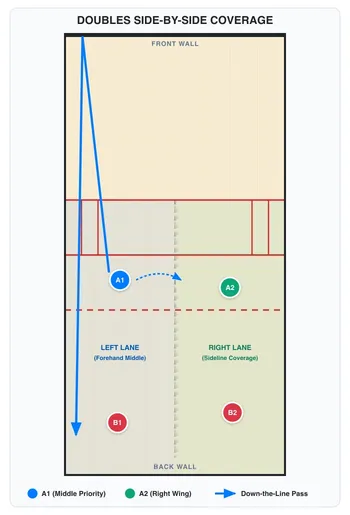
Side-by-Side (Left and Right Coverage)
This is the standard setup for almost every club and league team, and for good reason. One partner owns the left half of the court, and the other owns the right half. Your goal as a pair is to hold a line roughly just behind the short line, shifting forward or backward together as the rally moves.
If you’re lucky enough to pair a right-handed player with a left-handed player, put the righty on the left side and the lefty on the right side. That puts both players’ forehands in the middle of the court and covers both side walls cleanly. With two right-handed players (which is most pairs), the stronger backhand usually takes the right side.
Front-and-Back (I-Formation)
Some experienced pairs use an I-formation, where one aggressive player sits near center court looking to cut off short balls and pinch shots while the back player covers the deep corners and ceiling balls.
I’ll be honest: this setup takes serious chemistry and court awareness. If the front player turns around at the wrong moment or drifts into the hitting lane, things get dangerous fast. Unless you and your partner have played dozens of matches together, stick with side-by-side.
Who Takes the Middle?
Every doubles pair runs into the exact same awkward moment: a soft ball floats right down the center line. Either both players lunge for it and nearly clash racquets, or both players politely watch it bounce twice while saying “I thought you had it!”
Solve that before the match with one simple rule: Forehand takes the middle.
- With two right-handed players, the player on the left side has their forehand facing the center line, so they own middle balls by default.
- The exception is if the left-side player got pulled deep into the left corner and is out of position, or if the ball takes a clean bounce straight onto the right-side player’s racquet. In that case, call it loud and early (“Mine!” or “Yours!”).
Calling the ball half a second early prevents 90 percent of doubles collisions and wasted points.
Doubles Serving and Return Tactics
Serving and returning work a little differently when you’ve got an extra teammate standing in the box.
Serving With a Partner in the Doubles Box
Your non-serving partner has to stay pinned inside the 18-inch doubles box on one side of the service zone until the ball passes the short line. That temporarily leaves a lane open on their side if the return comes back quick.
- Use high lob serves or angled drives into the back corner on your own side when you want plenty of time for your partner to step out of the doubles box and settle into their half of the court.
- Avoid firing risky serves straight down your partner’s side wall unless you’re sure you won’t clip them (hitting your partner on the serve loses the serve immediately).
Returning Serves as a Pair
As receivers, both of you stand near the backcourt covering your respective halves. Don’t try to hit cute low kill shots from deep in the back corners with two defenders already camped up front. You’re trying to hit past two racquets instead of one.
Instead, favor high ceiling shots tight along a side wall or crisp down-the-line passes to push at least one opponent deep into the backcourt so your team can move forward together.
Shot Selection When Four Players Share the Court
Good singles shots aren’t always good doubles shots. In singles, a cross-court pass can fly right past an opponent standing in the middle. In doubles, hitting cross-court sends the ball right across the sweet spot where two opponents are waiting to cut it off.
Here’s what works much better with four players on the floor:
- Hug the side walls. Down-the-line passes and side-wall ceiling shots force one defender to dig out a tight corner while keeping the ball away from their partner in the center.
- Target the player who’s out of position. Keep an eye on which opponent got dragged up front or stuck deep on the previous shot, and send the next ball to their abandoned lane.
- Pick your spots on pinch shots. Pinches work great in doubles when you notice both opponents drifting deep behind the receiving line, leaving the front corners wide open.
Take two minutes before your next doubles match to agree on left/right sides, confirm who takes the middle, and commit to calling every shared ball out loud. You’ll immediately eliminate clumsy collisions, give up fewer cheap points, and have way more fun playing as an actual team.