
Racquetball Serving Strategy
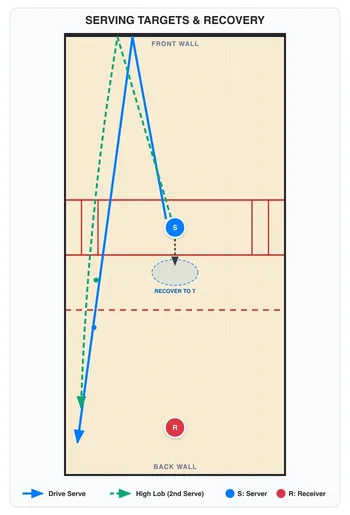
Serving is the one moment in racquetball where nobody is rushing you, nobody is blocking your view, and you already own center court. Yet a lot of beginners walk into the box and treat it like a speed-gun contest, hammering the ball as hard as possible and praying for an ace.
I used to do that every single game. I’d crack two massive drives straight into the back wall (or clip the short line) and hand the serve right back to my opponent without making them swing once. You don’t need to score aces on your serve to win points. You just need to put your opponent on the back foot so your next shot is an easy one.
Serving Is About Starting in Control
If you haven’t looked at the physical mechanics of each serve yet, start with the Racquetball Serves guide first. Once you can actually put a drive serve and a lob serve into play consistently, strategy is mostly about choosing the right tool for the moment.
A lot of players get stuck thinking drive serves are aggressive and lob serves are just safe backups. That’s only half true. A sloppy drive serve that bounces softly off the back glass gives your opponent a dream setup. A well-placed lob serve that dies in the backhand corner forces a weak defensive reply and lets you step right into an offensive winner on shot three.
First Serve vs. Second Serve
Since you get two chances to put a serve into play, those two swings have completely different jobs.
Your First Serve (Apply Pressure)
Your first serve is where you go on offense. A hard, low drive serve aimed deep toward your opponent’s back corner (or a sharp half-lob that catches them moving backward) puts real pressure on their footwork right away.
Still, give yourself a little margin over the short line. Aiming half an inch past the line might look heroic, but hitting short every third point burns your momentum fast.
Your Second Serve (Protect the Rally)
If you fault on your first attempt, don’t let stubbornness talk you into hitting the exact same risky drive serve again. Giving up a free sideout without making the other player earn it is one of the fastest ways to lose a close game (remember, you can only score points when you’re serving).
Switch to a high, controlled lob serve or Z-lob into the backhand corner. Keep it high enough to float past center court and soft enough that it won’t bounce violently off the back wall. Now your opponent still has to hit a good return, and you’re sitting in center court waiting for it.
Where to Aim (And Why the Backhand Wins)
For most club and recreational players, the backhand is noticeably weaker than the forehand, especially when the ball is tight to a side wall or dropping late near the back corner. Unless you happen to be playing someone whose backhand is noticeably stronger than their forehand, make that corner your primary target.
- Cross-court drive or Z-ball to the backhand - Forces your opponent to turn, reach across their body, and dig the ball out of the corner under speed pressure.
- High lob to the backhand - Makes them back up behind the receiving line and hit from shoulder height (or wait for an awkward back-wall bounce).
- Occasional forehand pass-court drive - Mix this in once every few serves just so they can’t camp out on their backhand side waiting for you.
One rule to keep in mind as you get more aggressive with angles: be careful not to hit a straight drive serve so close to your own body that your opponent loses sight of the ball as it passes you. That’s a screen serve, and under advanced rules it costs you a fault or forces a replay.
Deception and What You Do Next
Remember that while you’re setting up to serve, your opponent is watching your feet, shoulders, and ball toss for clues (we covered those tells in Serve Return Strategy).
- Use the same starting spot. Don’t stand on the far right side only when you hit Z-balls and stand dead center only when you hit straight drives. Pick a comfortable home spot in the service zone and hit multiple serves from it.
- Keep your toss consistent. If your ball bounce is high and relaxed on lobs but rushed and tight on drives, a sharp opponent will be moving before your racquet even meets the ball.
- Recover immediately after contact. The biggest serving mistake I still catch myself making is standing right on the service line admiring a great serve. The second the ball leaves your strings, take one or two quick steps backward behind the short line so you’re centered and balanced for the return (see Racquetball Court Positioning).
Adjusting Mid-Match
Pay attention to how your opponent handles your first few serves:
- If they’re short-hopping your lob serves aggressively (stepping up to the receiving line and attacking before the ball reaches the back wall), stop floating easy high lobs. Switch to faster half-lobs or hard drive serves that force them deeper.
- If they’re timing your fast drive serves cleanly, slow the pace down with a soft Z-lob or aim a straight jam serve closer to their hips so they can’t get a full swing.
Next time you step up to serve, pick two reliable first serves and one rock-solid second serve before the match starts. Stick to mixing those three deliberately, recover behind the short line after every swing, and watch how much easier it becomes to control the first three shots of every rally.