
Racquetball Rally Strategy
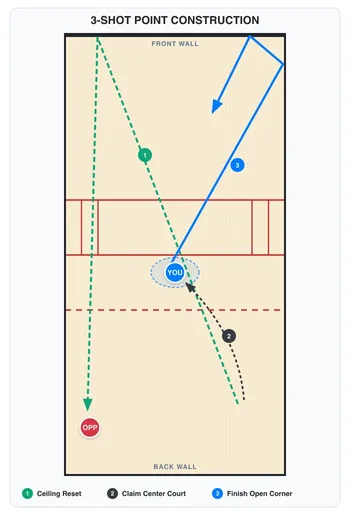
When you watch newer players play a pick-up game, most rallies last two or three swings. Someone hits a serve, someone blasts a wild kill attempt at the front wall, and either it rolls out or skips into the floor. Fun for five minutes, frustrating for an hour.
Better players treat a rally less like a home-run derby and more like building a point one brick at a time. You take what the ball gives you, force your opponent to take a couple of uncomfortable steps, and wait for an easy ball you can actually put away cleanly. That’s point construction, and it’s what ties Racquetball Court Positioning and Racquetball Shot Selection Strategy together during a real match.
Think Two Shots Ahead, Not Just One
The fastest way to level up your rally game is to stop looking at each swing in isolation. Before you strike the ball, you’re really deciding what kind of problem you want to hand your opponent next.
If you rush a low shot from behind the short line and it hits the front wall two feet high, it’s going to sail straight into mid-court at waist height. You didn’t just miss a winner. You handed your opponent a gift-wrapped setup while you’re stuck standing behind them.
On the other hand, if you absorb the pressure with a patient shot that pushes them into a deep corner, you’re setting yourself up to step forward and take the next ball on offense.
Stretching Your Opponent Around the Box
Most club players move pretty well when the ball stays near them in center court. They start making mistakes when you force them to run in two directions at once:
- Front-to-back stretch - Pair deep shots (like ceiling balls or deep down-the-line passes) with an occasional front-court pinch or soft kill. Once your opponent starts drifting backward early expecting another deep ball, drop your next clean mid-court setup into the front corner. Once they start creeping forward to guard the front wall, send a crisp pass right past them.
- Side-to-side stretch - Work one corner (usually their backhand) for two or three shots in a row until they start cheating toward that side wall. As soon as you spot them leaning over, open up the whole opposite side of the court with a cross-court pass or wide-angle pass.
You don’t need trick shots to make someone run. Just keep moving the target away from wherever they settled on the last swing.
Shifting Gears From Defense to Offense
Here’s what a patient, four-shot rally looks like in a normal game when you actually build the point instead of rushing it:
- You absorb a tough serve. Your opponent hits a crisp drive serve into your backhand corner, trapping you deep behind the receiving line.
- You reset with a ceiling shot. Instead of forcing a low kill from the back glass, you lift a controlled ceiling shot tight along their backhand side wall and start walking toward center court.
- They hit a compromised return. Your opponent has to retreat to the back corner, take an awkward shoulder-high swing, and hit a slightly loose pass that bounces up near mid-court.
- You finish from center court. Because you moved up during their retreat, you’re already balanced near the short line. Now you have a waist-high setup with your opponent pinned behind you, and you can step cleanly into a pinch shot or flat front-wall kill into the open corner.
Notice that shot four only existed because you refused to panic on shot two.
Controlling Pace and Energy Over a Full Match
Racquetball is brutal conditioning if you play every single rally at a dead sprint. Good rally strategy also means managing the tempo of the game so you aren’t gassed halfway through game two.
- Slow it down when you need a breather. If you just survived three frantic sprints or your opponent is in a hot rhythm cracking fast passes, lift a high ceiling shot. It buys you four or five seconds to walk back to center court, catch your breath, and break their timing.
- Speed it up when they look tired. When you notice your opponent leaning on their knees between serves or getting lazy with their footwork late in a match, push the pace. Attack lob serves early with a short-hop (see Serve Return Strategy) and fire crisp passing shots before they get set.
Next time you’re locked in a tight game, make patience your main weapon for one full game to 15. Trade clean ceiling shots and deep passes until your opponent leaves one ball sitting up in front of you, then put it away. You’ll win longer rallies, play cleaner points, and walk off the court with far fewer unforced errors.